
Knowledge Strategy, Security and Privacy
On data vulnerability
Recently I saw an item noting the 50th anniversary of the commercial success of the analog videotape cassette. It’s ironic that this technology, relatively new in the ‘long view’ scheme of things, is now decades obsolete — replaced in turn by the digital tape cassette, the digital disk (DVD) with all its higher-definition variants (Blu-Ray, 4K, etc.), and now streaming.
Physical substrate technologies develop so rapidly as to compromise our ability to archive our histories — a basic feature (or is it a bug?) of our knowledge-based civilization.
The technology changes brought by the passing of time were not so evident to me as a younger man. As my personal history continues to develop, my ways of recording it change too — sometimes pretty abruptly.
My time capsule
The other day I opened a safe deposit box near my old office that I had forgotten about — and had not visited in two decades. It was an unintended time capsule from my former lives.
Among other things of value, I had stored my intellectual property — business writings and musical compositions, precious if only to me. Of the five methods I had used to store my work, four were, for practical purposes, unusable by the time I opened the box.
My old Powerpoints were on a ZIP drive — a large physical cartridge that is long gone as a format. Some files I had burned to compact disk — which also contained some of my music. None of my half-dozen or so devices currently in use has a disk reader — though I’m sure it’s possible to find one if you really need to.

The Morgan Library main room
Most of my music was on analog tape cassettes. I tried one in my beloved (though long retired) Sony Walkman Pro. It sounded great, instantly took me back — until the long-neglected Sony started eating the tape. I also had some older stuff — live gig recordings from some of my college bands — on reel-to-reel tape, for which I long ago retired the player hardware.
Four strikes, I was definitely out. Except for storage method number five — print-outs of lyrics and chords to about 250 of my unpublished songs. Analog print saved the day — the kind I can see at the Morgan Library’s Gutenberg Bible, dating back nearly 600 years.
And let’s not get started on evolving hard disk formats — that’s a whole story in itself, from spinning platters in a range of sizes to today’s static flash RAM.
Information is static — knowledge is dynamic
I have long argued that while knowledge is organic and dynamic, data and information are static, as in the diagram below. That’s true under the best of circumstances — we generally don’t want our data to modify itself spontaneously without our intention.
But in the real world, data and information — though essentially intangible and ethereal — are stored on media (whether analog or digital) that are physical, tangible — and vulnerable.
This fragility stems from not only the technological obsolescence I’ve described here, but also the rigors of the physical world itself. Tape decays, plastic erodes, stuff happens — even to paper, which, of course, burns.
But the cloud fixes all this, right?
In some respects, yes. Ever since my catastrophic personal experience with things (including paper records and photos) during a flood, I’ve come to regard cloud storage as a safer and more manageable alternative to the physical world.
But the cloud introduces other risks, some potentially even more serious. Where is my data? Who has access to it? Is it secure? Who is responsible if it is compromised? What if my passwords suddenly no longer work (as I hear is currently happening with many people using Microsoft Exchange accounts)? What if my data is hijacked, encrypted, and held for ransom (as has happened to some hospitals)? And so on, a tale for another time.
Besides, the cloud is not magic — it has physical, and therefore economic, resource consequences. I recently spent most of a day pruning old emails, some from as early as two decades ago. Though it was interesting ‘visiting’ with old friends and clients, my main goal was to avoid being charged by my private email host for another tier of data storage.
Does this matter?
Around 100 CE, the codex was invented — better known as the book — pages bound together at the side. This was a great leap forward, as it allowed random access — ever try turning to page 135 in a scroll? This eventually rendered scrolls obsolete.
But, for roughly another 1400 years, books were ‘published’ by being hand-copied — when movable metal type became available. Some of the content was ’translated’ into the new format, I’m sure — but I’ll also wager it was a relatively small proportion. Substrate technologies evolve, tending to leave the content embedded therein as ‘orphans.’
But does any of this matter? Given that ‘what is’ changes much faster than our knowledge of it can — and that information follows knowledge in a distant third place, maybe this is OK. Maybe we should do a clean sweep of information every couple of decades or so — if, for nothing else, as a mechanism to keep our information base as fresh as possible.
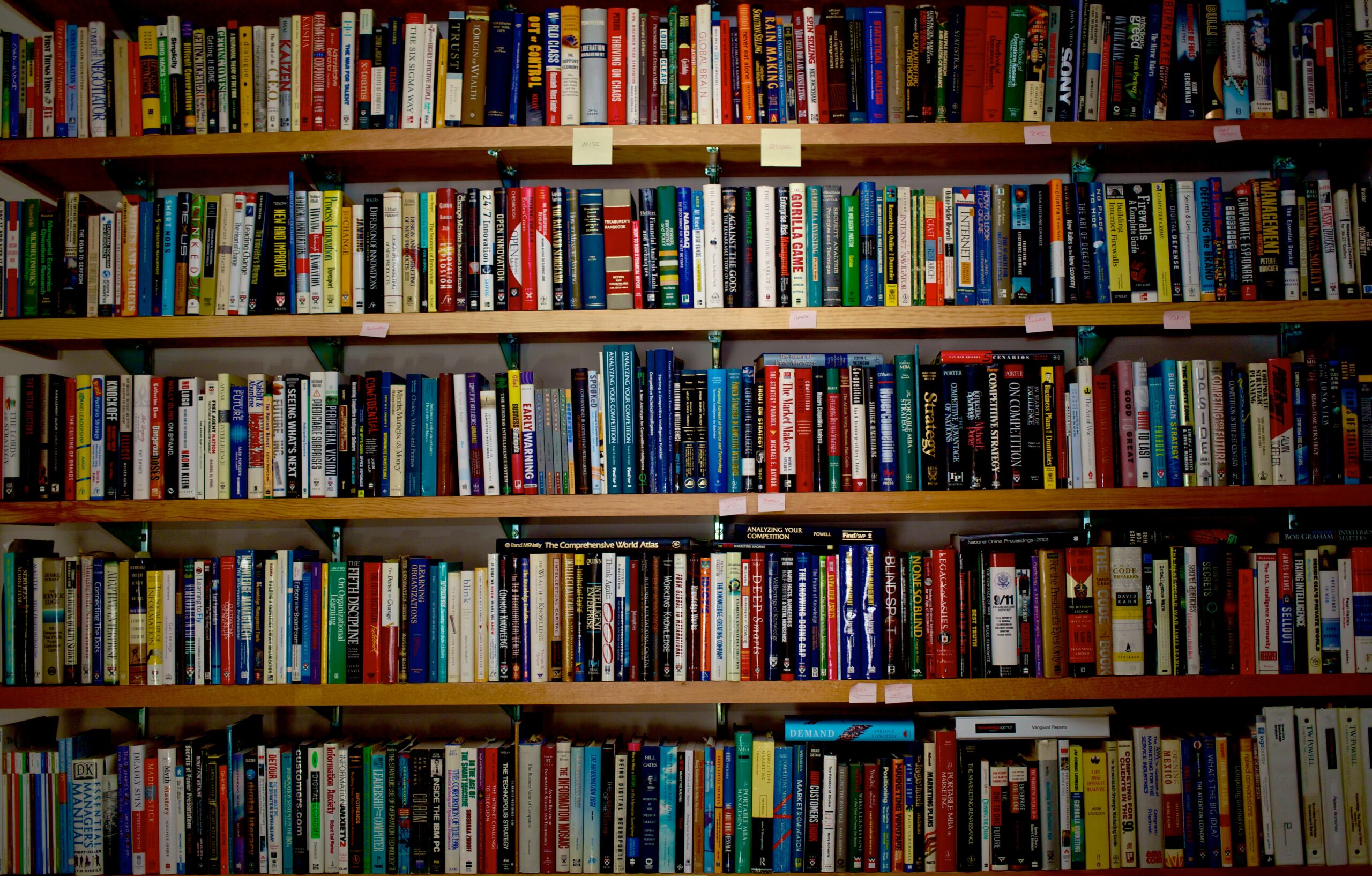
Business library in my office on West 28th Street – 2013
I once wrote a book about technology that was largely outdated within about two years of being published. Given that it took me about two years to write it, that was a ‘useful shelf life’ of about four years. I learned my lesson — and now write with much longer time horizons in mind.
A book begins its inexorable march toward obsolescence at the instant you you write it. The publishing cycle adds further to the lag time between your knowledge of something, your documenting of it, and its arrival at its intended audience.
A new era?
It’s even possible that we’re entering a new historical phase of the human experience. Long ago, around 700 BCE, some humans transitioned from spoken-only language to writing — orality to literacy. (With thanks to Walter Ong’s amazing book for this insight.) Once we had the Greek alphabet, Homer could write his epics The Iliad and The Odyssey. Following which we could have philosophy, science, and our entire knowledge-based culture.
Maybe now we’re moving toward a digital post-literacy phase — where the oral tradition is revived in the form of YouTube, TikTok, negligible-cost global video calling, and other audiovisual forms of communication.
“Print is dead” was a meme back in the 1960s, long before print media like newspapers and magazines started dying off. Maybe ‘writing is dead‘ is the next phase — which I suggest only with great trepidation. But the signs are not positive — like the rapid increases in bot-generate content and the steady declines in reading comprehension scores among schoolkids.
What is a library, anyway?
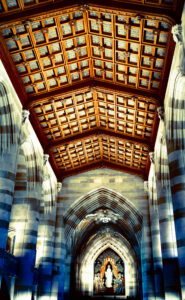
The Main Hall at Sterling Library, Yale
Library comes from the Latin liber — book, parchment, paper — and originally derives from the word for the bark of a tree that was used as an early writing substrate.
But a modern library is more than a collection of books. Last summer I visited Yale’s Sterling Library to make a personal ‘donation’ to its collection — by way of being interviewed for a digital oral history of New Haven club musicians (among whose ranks I briefly, but proudly, served.)
The librarian doing the interviewing and curation described to me one of its other recent acquisitions — hand-written manuscripts by the classical guitarist Andres Segovia. Neither of these two additions had to do with ‘books’ as such.
Books may even be deemed passé at a modern library. My first visit to the Yale School of Management’s then-new Evans Hall included a library tour — at which is was clear that there were few books in evidence. “Everything is digital now,” was the justification offered. I bit my tongue, having by that time written three published books, none of which was available digitally.
Do libraries have a future?

Yale Medical School Library, where I researched my first book
So, why do we need libraries at all? Are they merely expensive storehouses of out-of-date, hard-to-use information? Epistemic graveyards where once-fresh insights can rest in peace, undisturbed by the waves of evolving knowledge?
Is the ongoing cascade of media obsolescence just some normal self-cleansing process, so that information remains relatively fresh? Is it a natural, organic process — like shedding its skin would be for an animal?
With each technological advance, are there trade-offs we make, both explicitly and implicitly? What are these? What is gained? What is lost? I have more questions here than answers — but it’s worthy of serious investigation, I think.
In any case, the curation of content — whether books, manuscripts, or oral histories — remains a function essential to any knowledge-based society. And the role of the library as a venue where the information embedded in that content is transformed into knowledge by study and scholarship is equally essential.
Correction: infrastructure is critical
In a recent series of posts Parallel Worlds, I described the complex — and evolving — relationship between the physical world of atoms and things and the epistemic world of signs and symbols.
My KVC framework discusses the latter — but assumes the former. But it’s not ‘turtles all the way down.’ Our epistemic world rests on data, which in turn rest on two pillars — human labor (as discussed HERE) and physical substrate — chips, wires, electricity, and so on. Stuff that wears out and breaks down.

Our epistemic world depends upon physical infrastructure
So it’s probably more helpful to see the relationship, not as parallel, as but as hierarchical — as shown at right.
Data is the core resource that powers our organizations, our culture, and, increasingly, our entire civilization. So data quality and provenance are mission-critical challenges. Bringing ‘bad’ data into your organization is like pouring sugar into your car’s gas tank — with the added challenge that it’s difficult to detect, even when something goes wrong as a result.
But data quality relies in turn on the physicality of infrastructure: chips, disks, cables, and so on — with all of their finite limits and economic value ramifications — including, when scaled, macro-resources like power, land, and water.
Infrastructure is vulnerable
The vulnerabilities of substrate assets continue to evolve. They are now targets, not only of hacking, but also of ‘kinetic adversarial activities.’ Data centers in the Middle East have recently been bombed — and submarines have been found scouting undersea cables that can be severed, like a digital jugular vein. As I write this, Iran is threatening to impose fees to use data cables running underneth the Strait of Hormuz.
‘Data wars’ is no longer merely a metaphor — this now an integral element in how our wars are waged.
All human, no AI. Opinions and any errors are my own.
Photos © Tim Wood Powell. Lead photo is the Beinecke Rare Book Library at Yale.
Recent Comments
on PARALLEL WORLDS 3: Conflicts and Gaps: “Thanks, Henry, I agree. Language is indeed physical — muscles and other tissues moving, thereby producing sound waves. But –…” May 18, 12:31
on PARALLEL WORLDS 3: Conflicts and Gaps: “Love that! 🙂 Additional to that: Language at times can also be very ‚physical‘ within a neuronal network. [Emotion] :-)…” May 18, 09:41
on Enterprise Knowledge: What is it?: “This insightful analogy beautifully highlights the multifaceted nature of Knowledge Management. The “whole elephant” perspective underscores the need for cohesive…” Dec 30, 05:52
Comments RSS Feed