
IN MEMORY: Elizabeth Clay (“Kay”) Thurman Powell (1926-2004)

Kay and Jim Powell, my parents – 1998
Today is the 100th anniversary of my late mother’s birth. It’s only lately that I fully realize the sacrifices she made for me (and for my father and sister). Her challenges were in a sense those of many women of her era. I belatedly give voice to them.
She died in 2004, before the internet became huge part of the way we live and record history. Consequently, people today do not typically have the opportunity to know this extraordinary person and her work. My intention here is to partially correct that.
And if you were fortunate enough to know Mom and her work, I hope this will bring you some nice memories.
I also have a couple of more personal reasons for wanting to celebrate her: (1) to acknowledge the tremendous impact she had on my life and thinking; and (2) to indulge myself by bathing in the many fond memories I have of her.
From farm to Manhattan Project
Mom was born in Flint, MI, where her father (my grandfather, Neal Thurman) worked as a senior chemist for DuPont. His projects included making titanium-based auto paint, which is what had brought him to Flint under a contract from General Motors. He later worked on uranium enrichment through a post-war extension of the Manhattan Project under contract with the US government.
Dr. Thurman had come from humble beginnings, having been born on a small tobacco farm in rural Pulaski County, KY. His own family history was truly ‘diverse,’ as it included people who fought on both sides of the Civil War. The historical notables in the family also ranged widely — from ‘the great compromiser’ Henry Clay (the source of Mom’s maiden middle name) to Jesse James, the notorious bank robber and ardent anti-abolitionist.
Thurman’s determination to leave that life behind drove him to graduate at 19 from the University of KY in Lexington (where he met my grandmother, who was studying to become a teacher) and on to Northwestern outside Chicago, where (it is said) he earned his PhD in chemical engineering by age 22.
Thurman’s work eventually brought him back to DuPont headquarters in Wilmington, DE. He commuted there from nearby Delaware County, PA (near Philadelphia), where my mother and father (and later, I and my sister), grew up.
Tragedy I
Tragedy struck hard three times in my mother’s life — the first time early. When she was 14, her beloved ten-year-old brother “Chippie” was hit by a car in front of their suburban home and killed. The misfortune compounded when her parents decided to try to heal by taking an extended holiday in France — without my mother.
They shipped her off to the country relatives in Kentucky for several months. That would have been around the time she was in ninth grade — a time of rapid growth and socialization for most intelligent and accomplished young women, as she was.
Phone calls and travel were considerably more expensive than they are now, and she lost touch with many of her northeastern friends. She was out of place, abandoned by all at a tender age. Her country relatives were strict religious fundamentalists who looked askance at non-church music and dancing. They hosted her — but they didn’t understand her, and she was treated harshly.
This was traumatic for Mom — not only did she never completely forgive her parents, she never fully recovered emotionally. She did pick up some colorful stories and expressions from farm life — including how to kill a chicken for dinner — and her country nickname, “Betty Clay.”
She also got a baby brother, my uncle John. He was 14 years her junior, much closer to my age than Mom’s. “Johnnie,” as Mom always called him, was a lively, funny man who became a physician beloved by his patients. My mother adored him, and always seemed at her peak happiness in his company.
High school
Back in suburban Philadelphia for high school, Mom made a lifelong friend in the dynamic Ms. Sidney Smith. Sidney caught the bouquet at my mom and dad’s wedding, and soon married a young DuPont scientist, Tom Marshall.
Tom and Sidney lived with their five kids in a large house in nearby Chester County. They had a lot of friends and were astonishingly generous with their time and resources. They were like extended family to us — Sidney and Mom remained close throughout life.
I don’t recall any stories of her day-to-day life. But she did often tell the story of her high school classmate who, due to his Japanese ancestry, was suddenly deported to a domestic ‘internment camp.’ This clearly bothered her a great deal.
Ambitions
Mom was smart and hard-working, just like her father (and mother). When she expressed a desire to study chemistry, as he had, he objected — to the point of threatening to refuse to finance her education. He insisted that she study ‘women’s subjects’ like home economics.
She attended Swarthmore College and Middlebury, each for a year. She joined a sorority, now using her more sophisticated name, “Kay.”
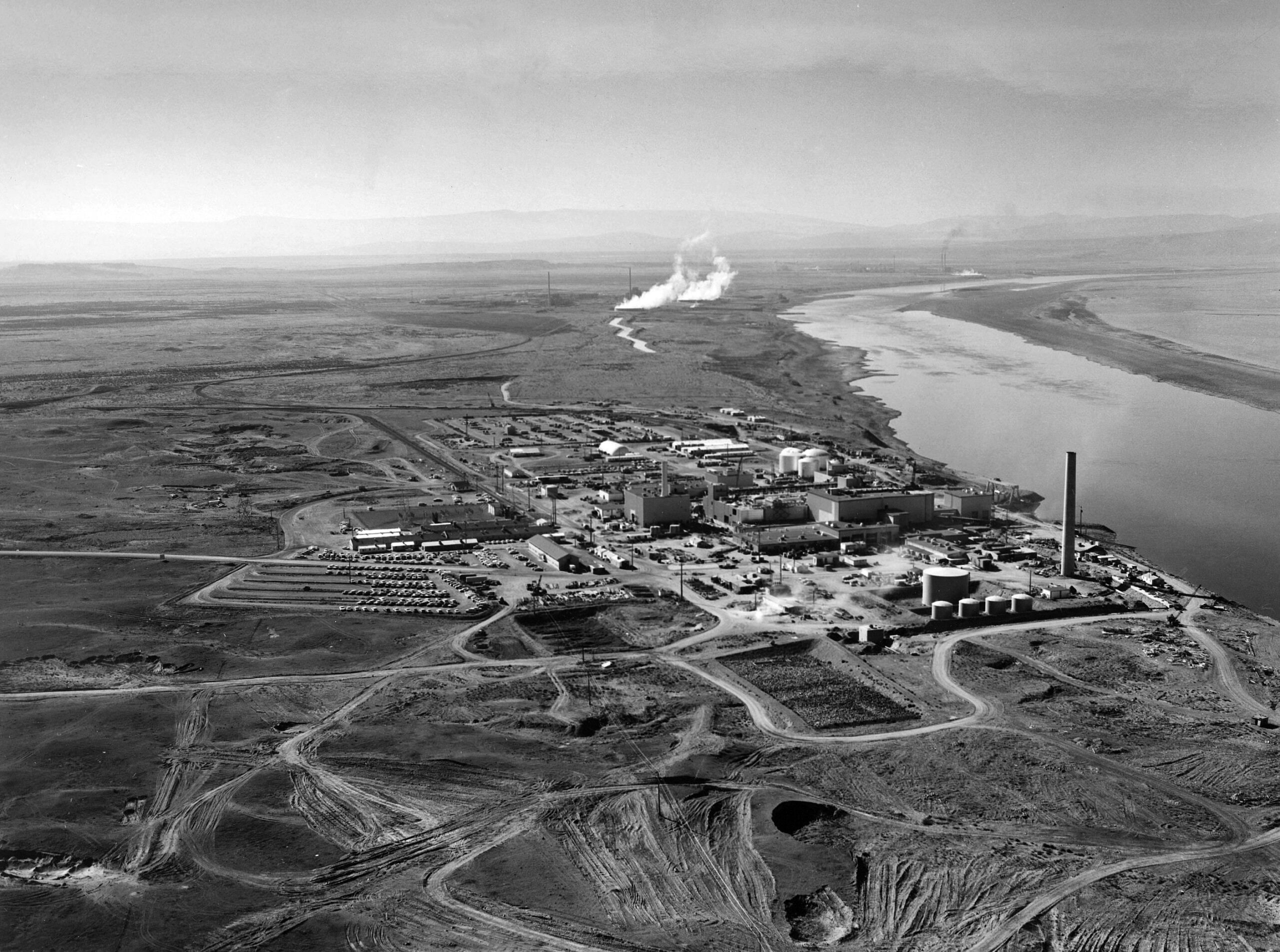
Nuclear enrichment plant, Hanford, WA. PHOTO: US Department of Energy.
Tragedy II
Going into her third year, Dr. Thurman was again transferred, this time to Hanford, WA to help run DuPont’s start-up nuclear enrichment facility there. Mom arranged to transfer her credits to the University of Washington. Weeks before the move, Dr. Thurman suffered a massive heart attack while rushing for a train — and died suddenly at 51.
Tragedy had struck again. But this time Mom had support from her fiancé, my dad — a handsome naval officer 11 years her senior. He was home on leave from his WWII assignments in the Pacific Theater. They lived in the same town and their families knew each other. He saw her act in a local amateur theater production — and was smitten.
After the War ended, they got married — she was 20 — and honeymooned in New York City. They were ‘blessed’ with me two years later — and my dear sister Susie two years after that.
Our little home

Our living room
In spite of her drive, intelligence, and ambition, Mom put her career on hold for two decades while she raised us. Thanks to her, we had a fresh meal every night — which we ate together after Dad got home from his office at a publishing company in Philadelphia. Her salads were especially delicious. Mom and Dad had a glass of dry sherry each night before dinner.
Mom was a terrific cook, but didn’t seem to relish the process of cooking. She was well-versed in the principles of nutrition and trained us to eat health-giving, clean foods long before it was in fashion to do so.
When I was young, she used a cookbook for kids to coach me through making some basic dishes. Gingerbread loaded with molasses was my favorite.
My parents liked people and often entertained small groups at home (which was tidy but ‘cozy’ by today’s standards.) My sister and I would get the benefit of some great left-overs — and of sopping up the remainder of drinks abandoned late the night before.
Visiting royalty
Mom spoiled me with attention. I remember her singing to me as a baby — a song called Pony Boy. To this I (at least partly) attribute my lifelong love of music.
She always showed a lot of interest in me and whatever I was doing. She and I talked often and long when I was growing up.
Later, when I’d come home from college, she and Dad would lavish their attention on me, almost like I was a visiting dignitary. I felt honored being in their home.
Mom loved heated discussions, and she had strong opinions. But she was not dogmatic — her opinions came from knowing what she was talking about.
Screen-free
When I was young, we didn’t own a TV — which at that time, wasn’t terribly unusual. My parents were always wary of electronic distractions — and absolutely against the continual corrosive presence (even in the 1950s) of guns and violence on screen.
I remember converging with other neighborhood kids on a house that had a TV to watch Howdy Doody and Micky Mouse Club each afternoon. Whether or not life was truly carefree and innocent then, it sure seemed that way to us kids.
Wild at heart
We had a big yard and it was only partially undeveloped woodlands around where we lived. I spent a lot of time outside playing capture the flag, basketball, and touch football with my buddies — untutored, unsupervised, and only minimally accountable. While other kids lived in housing developments with cozy names like Pine Ridge, we lived on subdivided former estate called Castle Thunder. To me as a kid, it was every bit as imposing as its name implied.
We were raised to be wild at heart; we liked it that way — and, to this day, I try to maintain some of that “Forever Wild” spirit.
Rainy days
On those rare occasions when we played inside, we had a stack of board games. Parcheesi was a favorite of Mom’s. She also loved cards — and taught me to play solitaire and poker.
Mom liked music. She had taken piano lessons and read pretty well from sheet music. But music was never as important for her as it was for my dad and me — for whom it was existential, part of our DNA.
Reading
Mom loved books and reading, as did Dad, and as did her mother. She devoured books on a wide range of topics and had similarly eclectic tastes in magazines — from Scientific American to the New Yorker to Mad magazine.
Mom would read stories to me as a kid. I remember her reading the story of Odysseus’ return after the Trojan War to his house and estranged wife Penelope — and especially the summary dispatching by bow and arrow of his wife’s many suitors. (It’s no wonder that this story has been retold for nearly 3,000 years.)
Mom guides me
When I got older, she tried her best to instill her love of reading in me by taking me to the local public library, where she worked as a volunteer.
At the time, I showed little interest. I was more of a hands-on science guy — catching creatures in the stream that ran through our yard, building model airplanes, and experimenting with my chemistry set. Back then I saw books as a distorted and somewhat random way of learning about the world — vastly inferior to direct observation. (A view that I have since upgraded to ‘somewhat inferior’ — if carefully vetted.)
Mom knew I was a tinkerer, and one day got me interested in the books Eleven Blue Men and Microbe Hunters. Stories of scientific discovery and technological advancement has always fascinated and inspired me, and those books helped crystallize that.
Mom loved books in general, especially non-fiction and especially history. She became an expert in Lewis and Clark, and the westward expansion of the fledgling US. So she managed to combine the two things I was least interested in: books and history. It was only much later that I came to see these two things as very important to me — and to understanding the world. Mom pointed me in the right direction; Life did the rest.
Late-blooming career
As a homemaker and ‘trad wife-homemaker,’ it didn’t seem that Mom ever felt comfortable. As soon as I and my sister were off at college, she finally started her career. Her first job was as a book editor. She went on to become editorial director at a financial college.
Word watching
While she was working, Mom’s tireless mind became fascinated with words — their derivations and histories. So much so that she created her own etymology newsletter, Wordwatching, that she published regularly and that gained an influential following. She raised awareness among her readers that words are shared tools of human communication (and, consequently, of community) — and that language is malleable, fragile, even whimsical at times.
One example I’ll never forget seems especially relevant now. According to Mom — and I have no reason to doubt her always-impeccable scholarship — the word cliché derives from 17th-century French printing industry. Typesetters found that it was more efficient to take commonly-associated words and mold these together as one piece of metal type — saving the time of setting each letter separately. “On the other hand” (or its equivalent en français) became a single slug that could be slotted in when that phrase occurred, as it did often.
As an aside, scholars of modern digital language models will note that this is essentially what LLMs do — albeit at enormous speed and scale. And why critics of the outputs of such models complain that the results often seem clichéd — since that’s literally what they are.
Arts and crafts

Quilt commemorating my wedding in 1979 (c) Estate of Key Thurman Powell
Mom was also a talented craftsperson. I wrote previously about her beautiful ceramic pieces, including the butterfly trivet, which I still treasure today. And, following a Kentucky tradition, she began later in her life making decorative quilts. She’d save scraps of fabric, research design ideas, work tirelessly — with amazing results.
Principles
Mom was socially aware and deeply principled. She marched in civil rights demonstrations in our local community. And she gave financial support to a Native American girl — whom my parents later visited on one of their many trips to the American Southwest after they retired.
Mom was known for her demanding standards in everything — for herself and everyone else. She was always looking to challenge the status quo by way of improving things. This had a good effect on me — I never developed the bad habit of becoming overly impressed with my own accomplishments.
She was was always busy, often intensively absorbed in the moment. Growing up I interpreted this as impatience — but now I see it more as a consequence of having lost two beloved people by the time she was 20. She was aware of the preciousness of time.
Mom had a gut-level distaste for nonsense and phoniness. When she occasionally got angry, you did not want to be in her way. I disobeyed her explicit wishes once — and only once, ever. When I was a senior in high school, I went out with my girlfriend and violated Mom’s home-by curfew by an hour or so. She didn’t speak to me for a week. Literally, not one word — and given how much we usually talked, this quickly had the desired effect on me.
House and home
Mom and Dad both loved gardening. They did all the around our house and yard themselves — it was their exercise and hobby. They were especially proud of their rose gardens.
Mom managed my sister and me as ‘hands’ to get the job done. We each had regular chores — mine were mowing the lawn tech week and burning the trash each day — as well as bigger projects to be done on the weekends (pullings weeds, raking leaves, and so on.)
She managed our household budget — recording each expense in a ledger book. We weren’t wealthy by any measure — but we always had whatever we needed, thanks to her diligence and planning.
She still had a drink before dinner — but her preference migrated toward Old Fashioneds — Old Grandad Kentucky bourbon, please.
Childhood’s end
Through several twists of fate, I got into Yale and was able to attend for four years on a scholarship. It was fours hours away geographically and a world away socially from the life I had known. When she and Dad took me to New Haven for the first time, Mom cried — the only time I ever saw her do that.
I’m sure she shed many tears in private, quietly. But she never let us see them — she was tough on the outside, soft on the inside.
I guess she knew already that the life we had enjoyed together was over. And I got quickly got busy with my new life, suddenly free of my self-imposed constraints of conforming hyper-achievement.
In those days, there was no email and calls were expensive and short. We drifted apart, trading letters now and again.
Tragedy III – the end
I saw my family after that as often as I could — several times a year for holidays and birthdays well into my adulthood. Through the many twists and turn my life took after that — some good, some not so good — Mom always let me know she loved and supported me.
And so did Dad, in his own way. They died suddenly, together, in 2004 when an electrical fire destroyed my boyhood home.
Weeks later, I started teaching in a library school — the first of several late-career academic experiences. Mom’s lessons had finally reached me. I’m sure she and I would have had some great conversations about it.
I guess we all long for that ‘one last conversation’ to tell those we miss how much the world has changed — and to begin to describe the immense debts we owe them.
Legacy
The sudden and profound pain of losing my parents was easily outweighed by the lasting, palpable feeling of their spirit within me. I continue to sense, as I always have, that they are never far.
My mother shaped me emotionally and intellectually in profound ways that, even at the time she died, I had yet to fully recognize. I’m pretty sure that, even now more than two decades later, I have not yet fully reached the limits of such realizations.
The lead photo is an array of my mother’s quilts. All photos (c) TW Powell, all rights reserved.
Recent Comments
on PARALLEL WORLDS 3: Conflicts and Gaps: “Thanks, Henry, I agree. Language is indeed physical — muscles and other tissues moving, thereby producing sound waves. But –…” May 18, 12:31
on PARALLEL WORLDS 3: Conflicts and Gaps: “Love that! 🙂 Additional to that: Language at times can also be very ‚physical‘ within a neuronal network. [Emotion] :-)…” May 18, 09:41
on Enterprise Knowledge: What is it?: “This insightful analogy beautifully highlights the multifaceted nature of Knowledge Management. The “whole elephant” perspective underscores the need for cohesive…” Dec 30, 05:52
Comments RSS Feed